
Emergencies never arrive with warning, they happen in a heartbeat.
Imagine this: you’re in the middle of a meeting, chatting with a colleague. Without warning, they collapse. No movement. No response. Someone shouts for help. You grab your phone, your pulse racing. In that moment, every second matters, and what happens in the next five minutes will decide whether that person lives or dies.
This is what a cardiac emergency looks like. And unless someone nearby knows how to respond with CPR and an AED (Automated External Defibrillator), the chances of survival drop rapidly with every passing minute.
At Jason Rowley Training, we teach people exactly what to do in those crucial first five minutes with our AED and CPR training. With the right training, knowledge, and confidence, anyone can save a life.
Why the First Five Minutes Matter
When someone’s heart stops, known as cardiac arrest, blood flow to the brain and vital organs stops immediately. Within three minutes, brain cells begin to die. After ten minutes without CPR or defibrillation, survival is unlikely.
That’s why early action is everything.
According to the British Heart Foundation, there are over 40,000 out-of-hospital cardiac arrests in the UK every year. Sadly, fewer than one in ten people survive, not because help doesn’t arrive, but because too few people act quickly enough before it does.
If CPR and an AED are used within the first few minutes, survival rates can triple. You don’t have to be a medical professional. You just have to know what to do.
Recognising a Cardiac Emergency
Cardiac arrest isn’t always dramatic, it can look like someone simply fainting or falling asleep. Recognising the signs early is the first step.
Common signs include:
- The person collapses suddenly and doesn’t respond.
- They are not breathing normally, or only gasping.
- They have no pulse or signs of life.
- Their skin may turn pale or bluish.
If you recognise these signs, don’t wait. Treat it as cardiac arrest and act immediately.
Step 1 (The 1st Minute): Check for Response and Call for Help
First, check the person quickly but safely.
- Tap their shoulders and shout, “Are you OK?”
- If there’s no response, shout for help.
- Ask someone to call 999 immediately and get an AED if one is available.
If you’re alone, call emergency services on speakerphone so you can continue helping while following their instructions.
Emergency call handlers are trained to talk you through CPR, but professional training ensures you already know exactly what to do, without hesitation.
This moment is the first link in the Chain of Survival: early recognition and calling for help.
Step 2 (1–2 Minutes): Begin CPR Immediately
If the person isn’t breathing normally, start CPR (Cardiopulmonary Resuscitation) straight away.
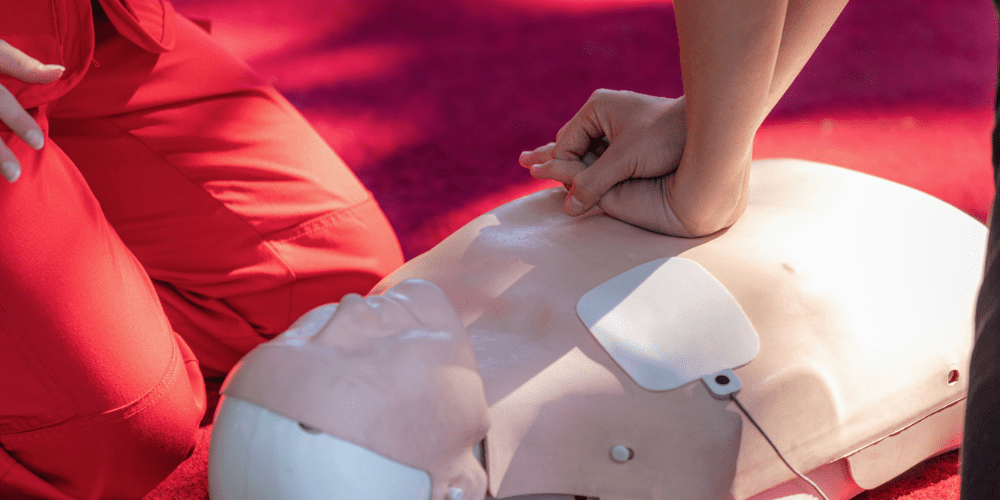
- Place the heel of your hand on the centre of their chest.
- Put your other hand on top and interlock your fingers.
- Keep your arms straight and push hard, about 5–6cm deep, at a rate of 100–120 compressions per minute (about two per second).
- Allow full chest recoil between each push.
- If trained, give 2 rescue breaths after every 30 compressions. If not, continue hands-only CPR.
CPR keeps oxygen moving through the body, buying vital time until a defibrillator or ambulance arrives.
Step 3 (2–3 Minutes): Locate and Use an AED
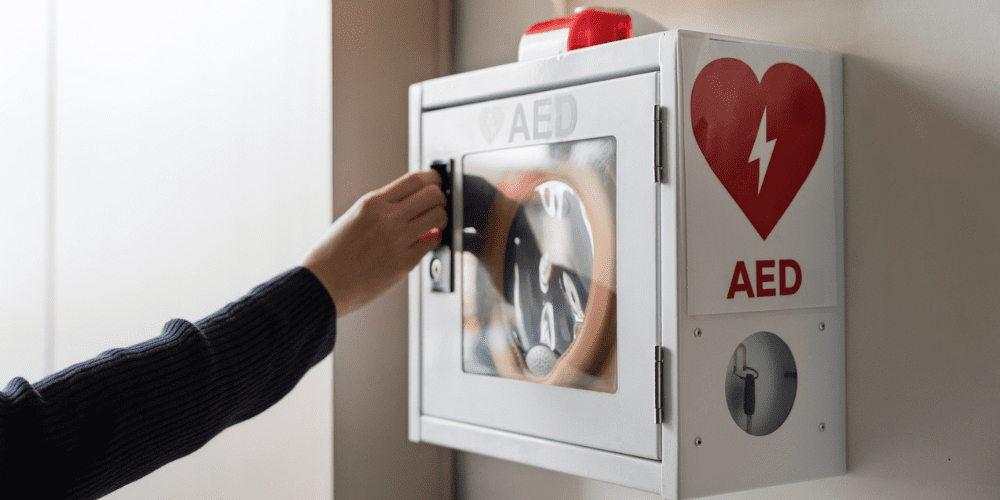
While CPR is being performed, someone should locate the nearest Automated External Defibrillator (AED). You’ll find AEDs in many workplaces, schools, gyms, and public buildings. They’re clearly marked with a green sign featuring a white heart and lightning bolt.
How to use an AED:
- Turn it on immediately, it gives clear, calm voice instructions.
- Remove clothing and attach the pads as shown in the diagram.
- Make sure nobody is touching the person when the AED analyses the heart rhythm.
- If a shock is advised, stand clear and press the flashing button.
- Resume CPR straight away until the AED tells you otherwise or help arrives.
You cannot accidentally harm someone with an AED, it only delivers a shock if needed. That’s why it’s safe for anyone to use, even without medical experience.
Step 4 (3–5 Minutes): Continue CPR and Support the Response Team
Once the AED is in use, continue 2-minute cycles of CPR with rhythm checks as directed by the device.
If you have multiple responders:
- Rotate the person performing compressions every two minutes to prevent fatigue.
- Keep one person responsible for AED prompts.
- Have someone meet paramedics at the entrance to guide them quickly to the scene.
Never stop CPR until medical professionals arrive or the person shows clear signs of life.
Common Mistakes to Avoid
Even well-meaning people can make errors during high-stress situations. Here’s what to avoid:
- Waiting for professional help instead of starting CPR immediately.
- Fearing you’ll “hurt” the person, in cardiac arrest, you can’t make things worse.
- Not using an AED because you think it’s “for professionals only.”
- Stopping CPR too soon.
- Forgetting to check the area for safety (traffic, live wires, fire hazards).
Training helps you overcome hesitation and recognise how to take control safely.
How CPR and AED Training Builds Confidence
Panic is a natural reaction in emergencies, but confidence comes from preparation. AED and CPR training transforms uncertainty into decisive action. At Jason Rowley Training, we use practical, hands-on teaching to help you:
- Stay calm under pressure.
- Remember the correct CPR sequence instinctively.
- Operate any type of AED confidently.
- Communicate clearly with emergency services.
- Work as a team when seconds count.
Our courses follow HSE and Resuscitation Council UK standards, ensuring you meet the same professional guidelines used by medical responders.
Be Ready When It Matters Most
Cardiac arrest doesn’t wait for the right time, place, or person. It can happen in a factory, an office, a school, or a breakroom. But with the right training, it doesn’t have to end in tragedy.
Every employer has a responsibility to protect their staff, and cardiac arrest is one of the few workplace emergencies where immediate action truly saves lives.
Our AED and CPR Training course gives you the essential, practical skills to step forward with confidence when every second counts. Don’t wait until you wish you’d known what to do. Learn essential AED and CPR training now, and be the reason someone gets a second chance at life.
Get in touch with our expert team for more advice, and consider signing up for our Emergency First Aid at Work course also on offer.